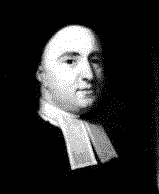


Eighteenth century Rhode Island’s most famous scholar was Irish clergyman George Berkeley (pronounced Bar-clay), Anglican essayist and philosopher, who renovated and resided at the beautifully preserved Whitehall Farm in present-day Middletown during his eventful stay in America from 1729 to 1731.
Berkeley was born in Ireland in 1685 and educated at Trinity College, Dublin where he then became a lecturer in Divinity, Greek, and Hebrew. In 1724 he was appointed Anglican Dean of Derry, and in 1729 Berkeley crossed the Atlantic to inquire into the condition and character of the North American Indians in expectation of a royal grant for founding a college for native American youth on the island of Bermuda. By accident or design, he landed in Newport in the company of Scottish-born artist John Smibert who had earlier emigrated to Boston and was returning to America after a period of study at Rome and London.
So warm was the welcome accorded Dean Berkeley by the local Anglican community in Newport’s Trinity Church and at St. Paul’s in Narragansett that Berkeley stretched his anticipated brief visit into a two-and-one-half-year stay. For his residence he bought a hundred-acre farm and remodeled its modest house into a stately mansion which he called Whitehall.
Already regarded as a great philosopher because of his early treatises expounding a neo-Platonic theory of reality called subjective idealism, Berkeley drew great crowds from all denominations for his regular lectures at Trinity Church.
A mile southerly from Whitehall on a rocky promontory commanding a view of the ocean, Berkeley had a favorite retreat where he kept a wooden chair and writing apparatus in a natural roofed alcove. It was probably here that he wrote two of his most celebrated works--Alciphron or The Minute Philosopher attacking those who based morality on “public benefit” rather than on a belief in God, whose existence, said Berkeley, “is the guaranty not only of the reality of the perceptible world but also of the moral”; and the poem On the Prospect of Planting Arts and Learning in America, best remembered for the oracular line “Westward the course of empire takes its way.”
Still hoping that the grant of government funds for building his college would materialize, Berkeley continued his interest in the welfare of the Indians and made repeated visits to the Narragansett Country with Smibert, Lodowick Updike, the proprietor of Cocumscussoc, and the Reverend James MacSparran, Anglican rector of St. Paul’s Church. Berkeley came to believe that Rhode Island was a much better place than Bermuda for his college and preferred a site on Hammond Hill in North Kingstown. However, the college grant was never made, and a disappointed Berkeley returned to Ireland in 1732 to continue his illustrious career. In 1734, he was consecrated Bishop of Cloyne where he presided until 1752 when he retired to Oxford. He died in this university town in the following year.
Berkeley never forgot his sojourn in Rhode Island. He sent a handsome organ from England to Trinity Church and made valuable donations of Latin and Greek classics to Harvard. He also provided that upon his death Whitehall and its library of some five hundred volumes should go to Yale College. At that time both Harvard and Yale were under Congregational auspices. Berkeley’s ecumenism and love of learning transcended sectarian boundaries.
African Americans | Agriculture / Farming | Architects & Designers | Artists & Painters | Banking / Finance | Business / Entrepreneurs | Civic Leaders | Civil Engineer | Civil Rights / Abolitionists | Craftsmen | Criminals / Rogues | Dance | Education & Universities | Explorers & Adventurers | Famous RI Families | Food / Culinary | Founders of Rhode Island | Government & Politics | Historians/Historical Accounts, Preservation | Immigrants: Chinese | Immigrants: Irish | Immigrants: Portuguese | Industry - General | Industry - Jewelry | Industry - Maritime | Industry - Textiles | Inventors & Inventions | Labor / Unions | Law / Legal Pioneers | Literature / Writers / Newspapers | Medicine & Health Care | Military | Music (Singers, Composers) | Native Americans | Olympic Athletes | Philanthropists | Religion & Churches | Retail Pioneers | Sports - Baseball | Sports - Basketball | Sports - Football | Sports - Golf | Sports - Hockey | Sports - Other | Technology & Science | Theater | TV & Radio | Women |